Lab Activity
Paper on Notification Placement Accepted to the 4th Conference on HCI at MIPRO 2026
We are pleased to announce that our lab's esearch paper has been officially accepted for publication and presentation at the 4th Conference on Human-Computer Interaction (HCI), part of MIPRO 2026, to be held in Opatija, Croatia, May 25–29, 2026. MIPRO 2026 is the 49th Convention, and papers presented in English are submitted for inclusion in the IEEE Xplore Digital Library. Title: Where Notifications Appear Matters: Eye-Tracking Evidence of Spatial Effects on Attention in Workplace Interruptions Authors: Ryan Hensley (2025 Lab Fellow), Jake Wilcox (2025 Lab Fellow), Patryk Suszko (2025 Lab Fellow), Sebastian Mesones (2025 Lab Fellow), and Dinko Bačić This study examined how the placement of workplace notifications influences subconscious visual attention during an ongoing office-style task. Using eye tracking, the paper investigated whether notification position affects how often users orient toward interruptions and how deeply they process them once noticed. Findings suggest that: - Notifications appearing on the left side of the screen attracted attention more frequently, producing higher fixation counts and more revisits. - Notifications appearing in the bottom regions led to longer fixation durations and greater dwell time, suggesting deeper processing once attention was captured. - Adding a sound cue to the default bottom-right notification did not significantly alter attention patterns, indicating that spatial placement may play a more important role than modality in shaping how interruptions are processed. These findings highlight the importance of notification placement as a meaningful interface design choice rather than a simple default convention. In digital work environments where interruptions are constant, this research offers insight into how workplace systems can be designed to better balance awareness and attentional disruption. We congratulate Ryan Hensley, Jake Wilcox, Patryk Suszko, and Sebastian Mesones on this accomplishment and look forward to seeing their work presented in Opatija, Croatia at MIPRO 2026. 4/06/2026 - UX & Biometrics Lab - Chicago, IL

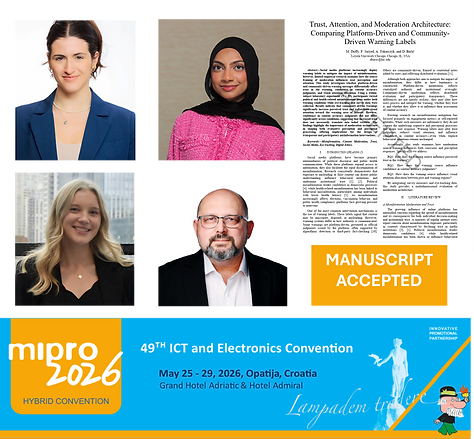
Paper on Misinformation Warning Labels Accepted to the 4th Conference on HCI at MIPRO 2026
We are pleased to announce that another lab's paper has been officially accepted for publication and presentation at the 4th Conference on Human-Computer Interaction (HCI), part of MIPRO 2026, to be held in Opatija, Croatia, May 25–29, 2026. MIPRO 2026 is the 49th Convention. Title: Trust, Attention, and Moderation Architecture: Comparing Platform-Driven and Community-Driven Warning Labels Authors: M. Duffy (2025 Lab Fellow), F. Saiyed (2025 Lab Fellow), A. Tokarczyk (2025 Lab Fellow), and D. Bačić This study examined how the source framing of misinformation warnings influences user trust, confidence in content-accuracy judgments, and visual attention allocation. Using a within-subject laboratory experiment with eye tracking and survey measures, the paper compared platform-driven and community-driven warning labels shown alongside political and health-related misinformation posts. Findings suggest that: - Community-driven warnings were trusted significantly more than platform-driven warnings, indicating that source framing meaningfully influences perceived credibility. - Community-driven warnings redirected more visual attention toward the warning area, producing greater dwell time, more fixations, longer fixation duration, and more revisits. - Confidence in content-accuracy judgments did not differ significantly across conditions, suggesting that greater trust in the warning did not necessarily translate into belief revision. These findings highlight the importance of moderation architecture in shaping both how users evaluate misinformation warnings and how they visually process them. More broadly, the study shows that participatory and community-framed moderation may influence trust and attention even when users’ final judgments about content accuracy remain stable. We congratulate Miranda Duffy, Farheen Saiyed, and Angelica Tokarczyk on this accomplishment and look forward to seeing their work presented in Opatija, Croatia at MIPRO 2026. 4/01/2026 - UX & Biometrics Lab - Chicago, IL
Sonya Voitenko Joins the UX & Biometrics Lab as Research Assistant
We are very excited to welcome Sofiia Voitenko (Sonya) to the UX & Biometrics Lab, Loyola University Chicago, as our newest Research Assistant! Sonya is a junior from Ukraine majoring in Information Systems & Analytics, and this semester she is beginning a fascinating research project on voice analysis in the context of U.S. presidential inaugural speeches. We are always proud to see students discover new knowledge and engage in research in meaningful ways, and Sonya’s project reflects the curiosity and analytical thinking we value in the lab. Welcome to the lab, Sonya! 3/23/2026 - UX & Biometrics Lab - Chicago, IL