Blinking: More than an Involuntary Reflex
Updated: Apr 12
Author: Karoline Shipton
Introduction
In the early 1900s, psychologists began to observe interesting patterns: blinking seemed to increase during moments of mental tension. A simple reflex, thought only to maintain moisture in the eye revealed so much more about human behavior. Today, we know that blinking serves more than just a biological purpose; it can be used as a behavioral biometric — something measurable that reflects human attention, cognitive load, and emotional state. So, the next time you catch yourself staring at something reminding yourself to “blink more” because your eyes hurt, let it serve as a reminder that your blink pattern actually is indicating how hard your brain is working..
What is a Blink?
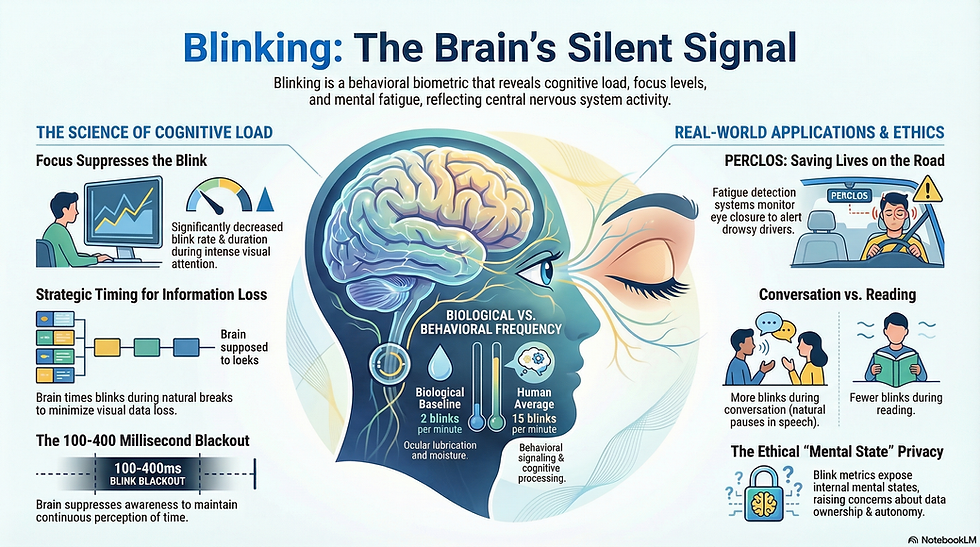
A blink is defined as a temporary closure of both eyes involving coordinated movement of the upper and lower eyelids. Blinking is a natural, involuntary human reflex — necessary for survival. On a basic level, blinking serves to distribute tear film across the surface of one's eye, acting as a protectant from debris for the eye’s surface. About 2 blinks per minute are actually necessary for the maintenance of ocular lubrication, yet humans blink an average of about 15 blinks per minute, greatly exceeding the necessary amount. This observation indicates that blinking does not just fulfill biological needs, but may be driven by additional factors. Beyond just hydration, blinking can tell us more about underlying neurological processes and human cognitive state. The movement of the eyelid is controlled by the levator palpebrae and orbicularis oculi muscles; muscles commanded by the central nervous system. Action from these muscles results in unique involuntary rapid movements of the eye that are incredibly difficult to replicate on demand. The inability to recreate these distinct movements allows for insight into real time behavioral signals, making them incredibly valuable for biometric studies
Blinking and Cognitive Load
The two most commonly studied attributes of blinking in cognitive science are blink duration and blink rate. Blink duration is the total time it takes for a full cycle of closure and re-opening of both eyelids. Blink rate is defined as the frequency of spontaneous blinks per minute. Research has continually shown that:
Blink rate decreases when performing tasks requiring intense visual attention
Blink duration decreases during states of high focus
Blink rate increases when one displays fatigue or attentional lapses
But, why is this the case? When we perform tasks that are visually demanding, such as reading, playing video games, or driving, our brain continuously prioritizes visual intake. Because blinking obstructs visual attention for approximately 100-400 milliseconds, the brain suppresses blinking to avoid information loss. As you read this blog post, odds are that your blink rate and duration have reduced because your brain is working to absorb the content you are reading, and blinking gets in the way of that. That being said, like with most activities, the brain will eventually tire. As you continue to carry out a task that demands high visual intake, resources in the brain get depleted. As these resources get depleted, blink rate and duration increase again, eventually returning to a baseline amount, indicating a decline in focus and cognition. Blink frequency often declines before noticeable performance errors occur, demonstrating its importance as a powerful signal of mental workload and a tool for error prevention.
Blinks and Attention
What makes blinking even more fascinating is that we do not consciously experience darkness or disruption, yet when we blink, visual input is temporarily lost. Research has found that the brain actually suppresses our awareness of the blink to maintain a smoother perception of time and sense of continuous visual intake. Our brain essentially erases blinks from our knowledge despite the temporary disruption. Furthermore, because blinks momentarily disturb visual processing, our brain deliberately times when we blink. Researchers studying reading behavior have observed that our brains often structure blinks at natural breaks in comprehension instead of mid word. These findings further demonstrate that blinking is associated with higher level cognitive processing..
Driving and Blinking: Accident Prevention
Driving is an example of a real world scenario where monitoring of blinks may save lives. Driving demands continuous visual focus and environmental scanning. When a driver demonstrates high levels of focus and engagement, their blink rate declines. However, when driving for long periods of time, blink duration and frequency begin to increase and attentional lapses emerge. Such observations often precede driving errors or accidents.
Some vehicles have implemented fatigue detection systems that utilize blink monitoring — specifically measuring the percentage of eye closure over time, or PERCLOS. Fatigue detection systems use blinks to detect driver drowsiness before an accident occurs. Implementation of such systems can save lives by alerting drivers when attentional lapses are detected. This application of PERCLOS isn’t limited to driving and can be utilized in many settings where engagement is vital.
Social Attention: Conversation vs Reading
Now that we have established a correlation between blinking and focus, it might be interesting to hear that people blink more during conversation than while reading. The act of reading demands a steady visual intake and cognitive processing. Conversation on the other hand has natural pauses as individuals take turns to speak, allowing for your brain to time blinking without loss of valuable information. Studies also suggest that during conversation, both parties might even synchronize blinking, reflecting a potential shared engagement or social alignment. This indicates that blinking may not just be biological and cognitive, but also social.
Ethical Considerations
As is the case with all biometric tools, blink monitoring can raise some ethical concerns. Some of the following are important considerations when it comes to collection of blink data:
Who has ownership of the data?
Should employers or educators actually monitor cognitive fatigue — is this ethical?
Does measurement of focus or engagement violate individual autonomy?
How should disclosure about such monitoring be addressed and how transparent should systems be about this data collection?
Unlike other observable characteristics used for identity verification, blink metrics expose an individual’s mental state, raising larger privacy concerns. As biometric technology continues to improve, it is likely that blink monitoring will become further integrated into devices and interfaces. For example, it is possible that computers may automatically adjust one's screen brightness based on blink patterns in the future to aid focus and engagement.
Conclusions
Blinking seems so insignificant, yet behind this subtle action hides a powerful signal about cognition, focus, and fatigue. Blinking provides a clear, measurable connection between muscular processes and one’s mental state, applicable in reading, driving, and so much more. As technology continues to evolve, biometric sensors and tools will continue to play larger roles in our lives, making understanding them increasingly important. The next time your eyes feel dry while reading, driving, or staring at a screen, remember that your blink pattern wasn’t just keeping you alive, but it revealed how hard your brain had to work
Interested in Learning More?
Want to Know if Somebody Is Truly Listening? Count Their Blinks.
https://www.sciencealert.com/want-to-know-if-somebody-is-truly-listening-counttheir-blinks
The timing of spontaneous eye blinks in text reading suggests cognitive role ○ https://pmc.ncbi.nlm.nih.gov/articles/PMC12141466/?
Feeling Drowsy? An In-Depth Look at PERCLOS for Driver Drowsiness Detection ○ https://www.ridgerun.ai/post/perclos-for-driver-drowsiness-detection
References
Bentivoglio, A. R., Bressman, S. B., Cassetta, E., Carretta, D., Tonali, P., & Albanese, A. (1997). Analysis of blink rate patterns in normal subjects. Movement Disorders, 12(6), 1028–1034. Dinges, D. F., & Grace, R. (1998).
PERCLOS: A valid psychophysiological measure of alertness as assessed by psychomotor vigilance. Federal Highway Administration, U.S. Department of Transportation.
Espinosa, J., Domenech, B., Vázquez, C., Pérez, J., & Mas, D. (2018). Blinking characterization from high speed video records: Application to biometric authentication. PLoS ONE, 13(5), e0196125.
Li, Y., Chang, M.-C., & Lyu, S. (2020). DeepVision: Deepfakes detection using human eye blinking pattern. IEEE Transactions on Information Forensics and Security, 15, 2316–2326.
Schleicher, R., Galley, N., Briest, S., & Galley, L. (2008). Blinks and saccades as indicators of fatigue in sleepiness warnings: Looking tired? Ergonomics, 51(7), 982–1010.
Sun, H., Li, Y., & Lyu, S. (2019). Blink detection for deepfake videos using eye aspect ratio analysis. IEEE International Conference on Multimedia and Expo Workshops (ICMEW).


Comments