Utilizing Biometrics for Pilot and Driver Fatigue and Drowsiness Monitoring
Author: Noah Lepore
Introduction
Two of the most important factors hindering human functioning are fatigue and drowsiness. Most people struggle with them, but for pilots and drivers, they can create life-or-death situations. Detecting fatigue and drowsiness early, before they become major problems, is critical to preventing accidents. In recent years, biometric technology has advanced tremendously, providing promising tools for real-time fatigue and drowsiness recognition. In the coming years, applications of this technology will continue to expand, helping identify signs of fatigue as early as possible. This blog explores the differences between fatigue and drowsiness, discusses key biometric devices that are making an impact (including eye metrics, blinks, pupil dynamics, voice changes, EEG markers, and heart rate variability), and explains the pivotal role these technologies can play in tackling safety challenges. While applicable to all forms of transportation, this blog will focus mostly on pilots and drivers, as they are most commonly discussed.
Understanding the Differences Between Fatigue and Drowsiness
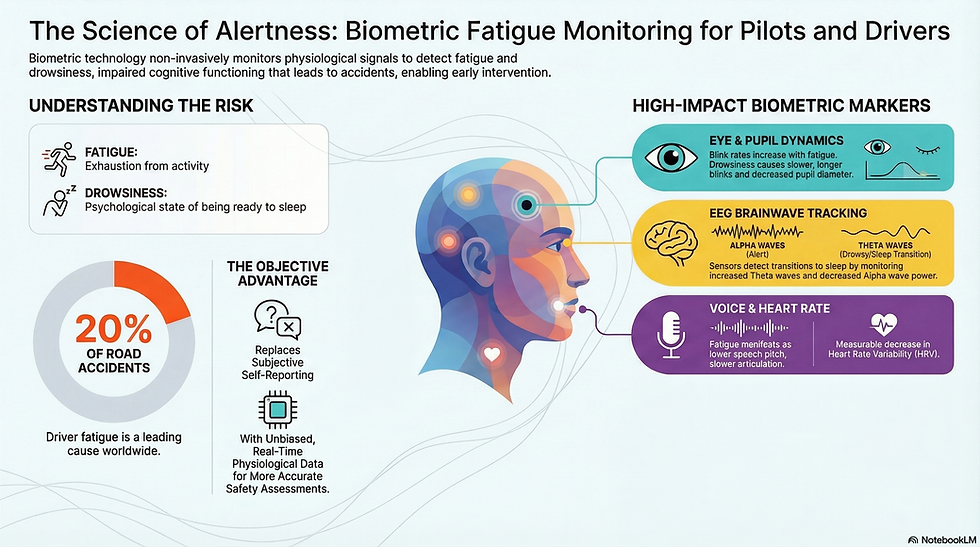
Many people use the terms fatigue and drowsiness interchangeably, but in reality, there are some differences. They each represent related, but differing states of mind that affect one’s level of alertness and cognitive functioning. Fatigue is defined as a state of physical or mental exhaustion resulting from prolonged activity, stress, or lack of sleep and rest (Limba et al., 2026). Primarily, fatigue affects attention, decision-making, and reaction time. Drowsiness differs from fatigue in that it is the psychological state of being sleepy or ready to fall asleep. It is a clear indicator of someone about to fall asleep, whereas fatigue is a more gradual decline in performance that can lead to drowsiness. These subtle differences demonstrate why any biometric monitoring system used for detection must account for a wide range of biometric signals. This is the only way to detect early warning signs before performance is affected.
Biometrics in Fatigue and Drowsiness Monitoring
Monitoring biometrics uses measurable physiological and behavioral signals to detect changes in an individual's alertness. Significant advances in biometric sensor technology, machine learning, and wearable devices have made it possible and easier to track these signals in real-world settings such as vehicles and cockpits. The devices and tracking information below outline the current capabilities and how they are being applied to address fatigue and drowsiness.
Eye Metrics: Blinks and Pupil Dynamics
One of the most reliable and non-invasive indicators of fatigue and drowsiness is the analysis of eye behavior, as these states alter blink patterns (Cori et al. 2022). Typically, as fatigue increases, blink rate will increase. However, when fatigue shifts to drowsiness, blinks become slower and longer. Prolonged eye closures are a key sign of drowsiness that can be identified through blink monitoring, as well as pupil size and reactivity, which provide insight into cognitive load and alertness. When fatigued, the pupil’s diameter decreases and shows a lower response to stimulation. Therefore, by monitoring pupil dynamics, early warning signs of fatigue and drowsiness can be detected. Modern eye-tracking technologies integrated into glasses or cameras in vehicles can capture these metrics in real time, helping drivers and pilots monitor fatigue without distraction.
Voice Changes
Voice analysis is an emerging biometric approach for assessing fatigue and drowsiness, and it has proven extremely useful, as fatigue affects speech characteristics such as pitch, tone, rate, and articulation (Zhang et al., 2025). This is shown through speech that becomes slower and less precise, a lowering of voice pitch, more monotone speech, and prolonged pauses between words. Voice monitoring can be used to analyze these aspects using microphones placed in helmets or in the interiors of vehicles, providing a non-intrusive way to detect early signs of fatigue.
Electroencephalography (EEG) Markers
Electroencephalography (EEG) records activity in the brain and is considered to be one of the top methods for assessing the mind. There are specific EEG markers, such as increased theta wave activity and decreased alpha wave power, that can be associated with fatigue and drowsiness (Borghini et al., 2014). EEG can detect when the vehicle operator or pilot transitions from wakefulness to a state closer to sleep before behavioral signs show up. In the past, EEG was mainly used in laboratory settings due to the amount of equipment required to obtain insights. However, EEG headsets have evolved in recent years, making it possible to monitor subjects in non-lab environments. For example, a pilot in the cockpit and a driver in the front seat of a car. They can wear the headset, still perform all of their duties, and remain undistracted. As EEG technology continues to develop over the next few years, the goal is for its invasiveness to decrease while its effectiveness increases.
Heart Rate Variability (HRV)
Heart rate variability (HRV) is the variation in the time between heartbeats and is a sensitive marker of autonomic nervous system activity and stress; it can also help identify fatigue, as it typically results in decreased HRV (Qin et al., 2021). This has been less commonly used to identify fatigue and drowsiness, but could provide one of the easiest non-invasive applications. Continuous HRV monitoring via wrist devices and other wearables can provide valuable insight into the fatigue levels in drivers and pilots. Combining HRV data with other biometric data would enhance the overall accuracy of current systems for detecting fatigue.
Applications in Drivers and Pilots
Effective fatigue and drowsiness monitoring and sensors are particularly necessary in the transportation sector. Driver fatigue is a leading cause of road accidents worldwide, contributing to around 20% of them (Shekari et al. 2022). Pilot fatigue contributes to many aviation incidents and has become increasingly common in recent years, amid the pilot shortage (Hancock et al. 2023). This shortage places a much greater workload on existing pilots, increasing the risk of fatigue-related incidents on flights.
For drivers, integrating biometric fatigue detection systems into vehicles can have life-saving effects by alerting them before fatigue reaches dangerous levels. There are many ways biometric devices can be integrated to help keep drivers safe. These include eye-tracking cameras to monitor blink patterns and the driver’s gaze, voice analysis to detect changes in speaking tone, and wearables that track HRV and other important biometric metrics.
For pilots, integrating biometric devices that detect fatigue and drowsiness into the cockpit can be crucial in preventing accidents and missteps. Using information gathered from biometric devices provides much more accurate and objective insight into the pilots' actual condition. Historically, pilots have self-reported their experiences on planes, meaning the data isn’t objective and comes from the source (the pilot). There are ways to integrate biometric trackers into the cockpit so that pilots are more likely to have their fatigue and drowsiness detected. These include wearable EEG devices that track the pilot’s brain activity, eye-tracking metrics to support alertness during critical flight phases, and HRV sensors that provide continuous feedback on the pilot’s cognitive state.
The Importance of Early Detection
The most valuable aspect of biometric fatigue and drowsiness monitoring is its ability to detect them early, before performance is impaired to a dangerous level. Traditional methods of evaluating fatigue level, such as subjective self-assessments or fixed rest schedules, often don’t account for variation in individuals' fatigue levels and for factors like stress, workload, and sleep quality that affect fatigue in the moment. By tracking biometric levels, one can continuously monitor someone’s fatigue and drowsiness levels, enabling objective insights free of personal bias. Detecting early is very important because it can save lives. It enables immediate action, such as sending alerts, recommending periods of rest, and suggesting workload adjustments.
Challenges and Future Directions
While there has been a lot of progress in recent years, many challenges persist in adopting biometric technology. External factors such as lighting, loud noise, and physical movement affect the reliability of many biometric devices, making it very difficult to obtain accurate data. Another concern is privacy. The idea of continuously monitoring an individual’s biometric information can be alarming to some. This also raises data privacy and security concerns, as some are already reluctant to share basic information because they’re afraid it’ll be stolen. Finally, people may not be willing or able to adopt this technology. Its invasiveness is not something people would be overly excited about. This is why additional research, improved device designs, and transparent biometric data policies must be addressed to deal with the aforementioned concerns. As AI continues to grow, it will almost certainly weave its way into biometric research, hopefully leading to less invasive, more accurate fatigue and drowsiness tracking.
Conclusions
While not new, biometrics offer an opportunity to make monitoring and addressing fatigue and drowsiness among pilots and drivers easier and more objective. By understanding the differences between fatigue and drowsiness and using key biometric indicators such as eye metrics, blinks, pupil dynamics, voice changes, EEG markers, and heart rate variability, it becomes easier to prevent accidents. Because there are many safety risks associated with operating a car or a plane, the use of these devices is necessary. Implementation and continued innovation of these devices will make the roads and skies safer by reducing fatigue- and drowsiness-related incidents.
References
Borghini, Gianluca, et al. “Measuring neurophysiological signals in aircraft pilots and car drivers for the assessment of mental workload, fatigue and drowsiness.” Neuroscience &; Biobehavioral Reviews, vol. 44, July 2014, pp. 58–75, https://doi.org/10.1016/j.neubiorev.2012.10.003.
Cori, Jennifer M., et al. “A brief assessment of eye blink drowsiness immediately prior to or following driving detects drowsiness related driving impairment.” Journal of Sleep Research, vol. 32, no. 3, 7 Dec. 2022, https://doi.org/10.1111/jsr.13785.
Hancock, Katherine. “The airline pilot shortage: A result of age discrimination or excessive training requirements?” Journal of Air Law and Commerce, vol. 88, no. 2, 2023, p. 535, https://doi.org/10.25172/jalc.88.2.5.
Limba, N., et al. “Similarities and differences between fatigue and drowsiness.” Sleep Medicine, vol. 138, Feb. 2026, p. 107008, https://doi.org/10.1016/j.sleep.2025.107008.
Qin, Hao, et al. “Detection of mental fatigue state using heart rate variability and eye metrics during simulated flight.” Human Factors and Ergonomics in Manufacturing & Service Industries, vol. 31, no. 6, 24 June 2021, pp. 637–651, https://doi.org/10.1002/hfm.20927.
Shekari Soleimanloo, Shamsi, et al. “The Association of Schedule Characteristics of heavy vehicle drivers with continuous eye-blink parameters of drowsiness.” Transportation Research Part F: Traffic Psychology and Behaviour, vol. 90, Oct. 2022, pp. 485–499, https://doi.org/10.1016/j.trf.2022.08.019.
Zhang, Guoxin, et al. “Adaptive detection method for driver fatigue using facial multisource dynamic behavior fusion.” Engineering Applications of Artificial Intelligence, vol. 162, Dec. 2025, p. 112482, https://doi.org/10.1016/j.engappai.2025.112482.


Comments